For upstream oil & gas facilities engineering
One facility spec. A P&ID set and a cost estimate, both auditable.
PadSpec turns an operator's rates, basin, and regulatory context, plus your firm's engineering practice, into a sized equipment list, a P&ID set issued for review, and a Class 4 estimate priced from a cost library your firm owns. Every line on the drawing cites the rule that put it there; every dollar cites the library entry it came from.
Drawings are issued for review and watermarked preliminary. Your engineer of record checks and seals; PadSpec never represents a drawing as issued for construction.
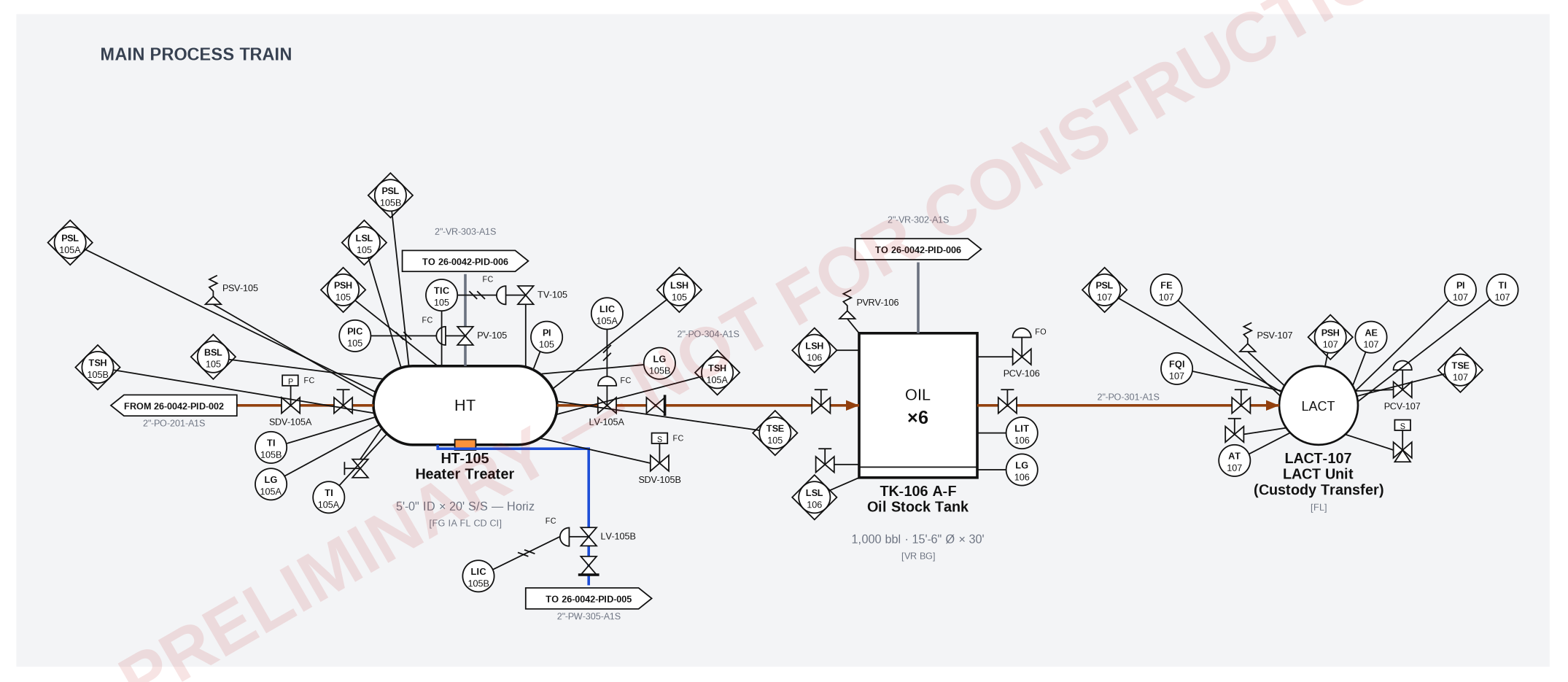
Real engine output. Not a mockup. Cropped from one of nine sheets in one generation.
What changes
The front end of every facility project, done by one engineer in an afternoon.
Scoping, equipment sizing, the drawing set, and the budget estimate are rules-based engineering. PadSpec runs those rules so your engineers spend their time on the parts that need judgment, and hands the operator a package they can audit.
- An equipment list from memory and a phone callA sized equipment list with every rule cited
- A hand-drafted PFD, then weeks to a P&IDA nine-sheet P&ID set issued for review in one run
- A cost spreadsheet rebuilt per projectA Class 4 estimate from the same spec, with its basis
- Pre-sell number and final design drift apartOne spec version behind the drawing and the dollars
- Your senior engineers' judgment in their headsYour firm's rules and costs, encoded once, inherited by every project
How it works
Four steps. Same flow, every facility.
- 01
Capture operator intent
An eight-step wizard collects rates, fluid properties, basin, regulatory context, and equipment preferences. Basin defaults fill what the operator did not state, and every default is recorded as an assumption.
- 02
Run the rule engine
Core rules and your firm's overlay fire deterministically: equipment selected and sized, topology resolved, control loops and safety devices placed, lines numbered. Every decision cites its rule.
- 03
Issue the P&ID set for review
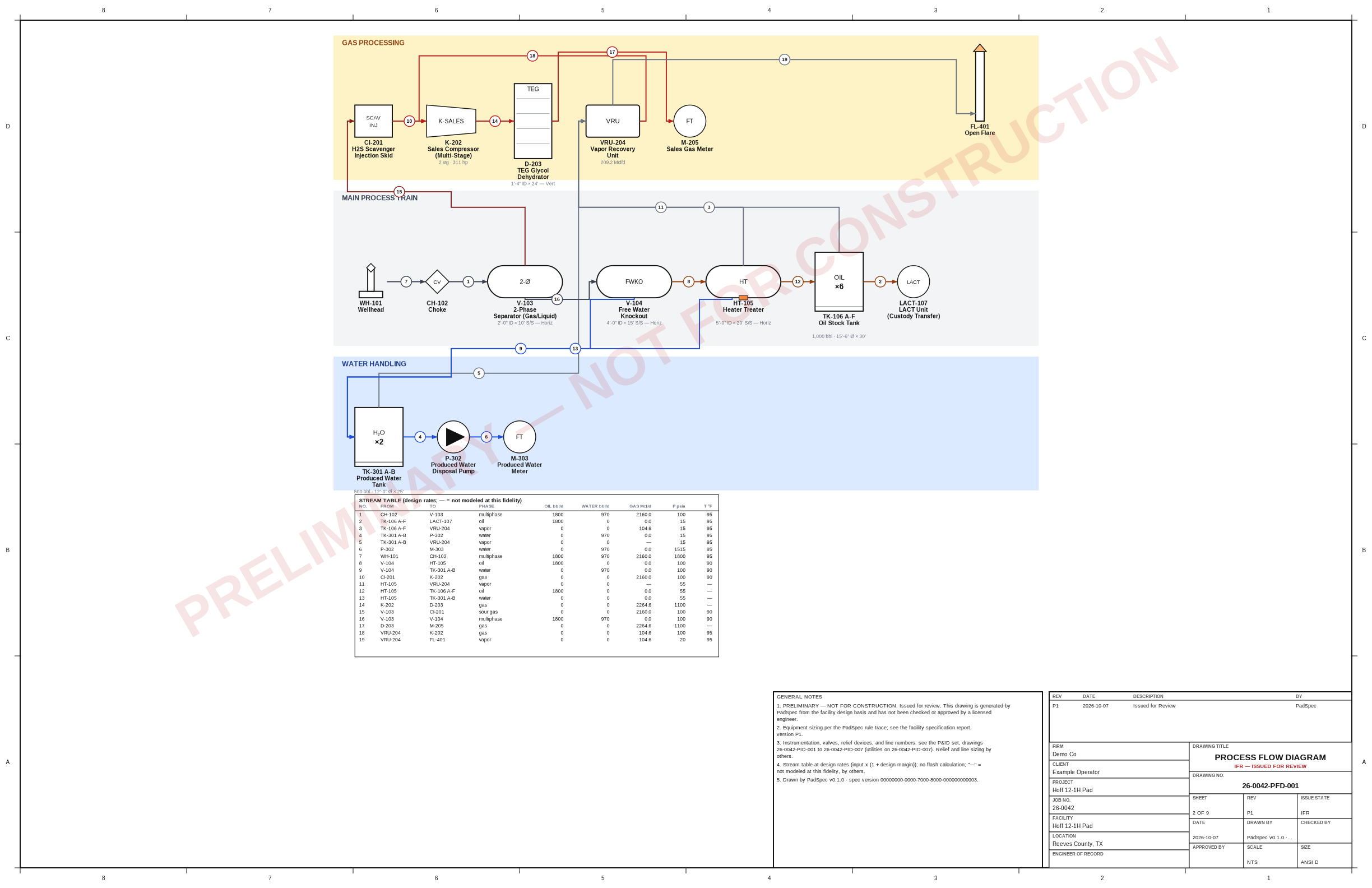
Legend, PFD with stream table, one P&ID per system, utilities, and the instrument index, SAFE chart, PSV list, and line list. Vector PDF, DXF per sheet, and DEXPI XML for your CAD and the operator's.
- 04
Price it from the cost library
The same spec version maps to cost modules and prices as a Class 4 estimate through an eleven-layer stack, with readiness checks, a basis of estimate, scenarios, and a report. Your closed projects calibrate the library.
What you hand the operator
From one spec version, the package a facilities engineer is asked for.
Everything below comes from the same generation. Change an input, regenerate, and the drawings, the lists, and the estimate move together, with the version history to show what changed and why.
The P&ID set
Issued for review, watermarked preliminary, for your engineer of record to check and seal.
- Legend sheet with the drawing index and every symbol used
- PFD with stream numbers and a heat and material balance
- One P&ID per system: control loops, safety devices, numbered lines, off-sheet connectors
- Utilities sheet: fuel gas, instrument air, flare and vent header, drains, chemical injection
- Instrument index, SAFE chart, PSV list, line list
- Vector PDF at ANSI D, DXF per sheet, DEXPI XML
The estimate
Class 5 screening in minutes, Class 4 from the equipment list, with the basis a reviewer asks for.
- Class 5 range from a capacity reference and your firm's closed projects
- Class 4 line build-up: equipment, bulks, labor, subcontracts per module
- Eleven-layer stack through indirects, taxes, fee, escalation, contingency
- Readiness rules that check the class claimed; justification when they do not
- Basis of estimate, scenarios, version history, line-by-line diff
- Estimate report as PDF and workbook; actuals reconciliation and calibration
Your firm's libraries
The core seed plus your overlay: rules, drawing conventions, and costs, with provenance on every entry.
- Sizing margins, vendor preferences, and basin practice as firm rules
- Tag classes, service codes, and pipe classes as drawing conventions
- Cost curves, crew rates, and factors that replace the seed by code or by band
- Draft, preview against open work, activate; a second reviewer when you require one
- Immutable snapshots: every deliverable names the library state that produced it
- Export of your own content, any time, in the import layouts
See it work · one worked example
From six operator inputs to a drawing set and a priced estimate.
The engine handles single-well pads, multi-well central tank batteries, gas pads, and water-handling facilities across the Permian, Bakken, Eagle Ford, Marcellus, and Haynesville. The inputs change, the rules that fire change, the sizing and the price change. The auditable output shape stays constant.
Below is one worked example: Hoff 12-1H Pad, a single-well oil-weighted pad in Reeves County, TX · Permian Basin.
- Oil
- 1,500 bbl/d
- Gas
- 1,800 mcf/d
- Water
- 808 bbl/d
- GOR
- 1,200 scf/bbl
- H₂S
- 8 ppm
- Future water cut
- 55%
- 16
- equipment items sized and tagged
- 11
- design rules fired, each cited in the trace
- 9
- drawing sheets: legend, PFD, six P&IDs, utilities
- 78
- safety devices placed by API RP 14C logic
- 65
- instruments with ISA tags and loops
- 3
- engineering warnings surfaced for review
- R003Free-water knockout added: the water rate justifies upstream separation.
- R020Two oil tanks specified for five days of storage with a redundancy buffer.
- R040TEG dehydrator required to meet the sales-gas water-content spec.
- R060Vapor recovery unit required: storage-vessel vapor control applies under NSPS OOOOb and the gas has a sales path.
- R080LACT unit required because the oil sales destination is pipeline.
6 more rules fired on this pad. Every citation is tied to the spec version that fired it and the rule-library snapshot in force, so a reviewer can trace any decision to its source.
| Major equipment | $1,141,901 | curve price at its index date, escalated to the estimate date, by line |
| Bulk materials | $228,355 | module material-only factors of equipment by discipline |
| Construction labor | $293,007 | crew hours by discipline x composite crew rate x productivity |
| Subcontracts | $69,227 | module subcontract allowances |
| Indirects | $369,988 | percent of directs by category |
| Taxes | $100,874 | 8.25% on the taxable base (Texas sales and use) |
| Engineering and PM (fee) | $136,661 | 6.5% of directs plus indirects |
| Owner's costs | $0 | listed allowances |
| Escalation | $94,374 | estimate date to the construction midpoint, by category |
| Contingency | $486,877 | 20% fixed percent on every layer above it |
| Total, P50 | $2,921,263 | AACE 18R-97 Class 4 band -30% to +50%: $2,044,884 to $4,381,894 |
Priced from the core seed library alone, which the product labels seed-only on every line; 31% of the direct cost rides on placeholder prices and the estimate says so. A firm's own rates, curves, and closed projects replace these numbers. How the estimate is built
Why teams use it
Built for engineers who will check.
PadSpec is a layered rule engine and a layered cost library with a drawing renderer on top. It does the repeatable front end of a facility project deterministically and shows its work, so the people who sign the drawing and defend the number can trust what they are signing.
Auditable on the drawing and in the dollars
Every line on a P&ID cites the rule that placed it; every line on the estimate cites the library entry, its revision, and its index month. A reviewer, an operator's auditor, or your own QA can answer 'why this device, why this size, why this price' without a phone call.
Your firm's practice, encoded once
Senior engineers author overlays at the firm level: sizing margins, vendor preferences, drawing conventions, crew rates, cost curves. Every project inherits them. The core seed stays underneath, revised by us, never overwritten by you.
One spec version behind both deliverables
The estimate prices the same spec version that drew the P&ID. When the spec changes, the estimate knows it is stale, shows what moved on the equipment list, and re-costs with your edits carried forward. No parallel spreadsheet to reconcile.
Honest about what it knows
Drawings are issued for review and watermarked until your engineer of record seals them. Prices carry a confidence: calibrated by your closed projects, seed-only, or placeholder. Readiness rules decide which estimate class the inputs support, and the report says so.
Spec, draw, and price your next pad in an afternoon.
Bring a facility from your basin. We will run it end to end: the sized equipment list, the P&ID set issued for review, and the Class 4 estimate with its basis, with your firm's practice as the overlay. Create an account or book a walkthrough. There is no charge during the pilot.